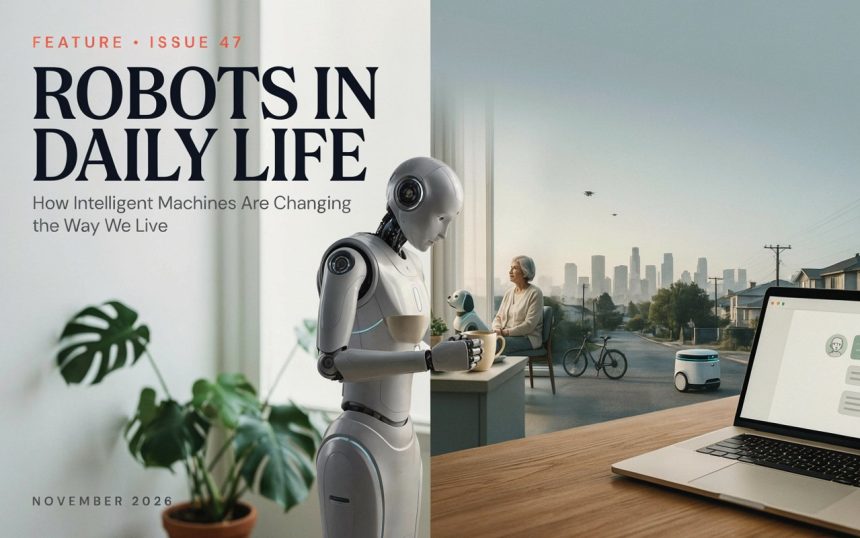
Technology has become a natural part of modern living, and one of the biggest changes is the growing presence of smart machines in everyday routines. From cleaning our homes to helping doctors perform delicate surgeries, these advanced systems are making life easier, faster, and more convenient. What once seemed like science fiction is now part of our daily experience.
You may not even notice how often you interact with automated technology. Ordering food online, receiving package updates, using a voice assistant, or riding in a modern car all involve intelligent systems working behind the scenes. Think of them as silent partners—always ready to lend a hand without demanding attention. Like electricity, they often work quietly in the background while making everything around us function more smoothly.
In this guide, we’ll explore how these machines are transforming homes, healthcare, education, transportation, workplaces, entertainment, and much more. We’ll also discuss their benefits, challenges, and what the future may hold.
What Are Robots in Daily Life?
When people hear the word “robot,” they often imagine a human-shaped machine walking and talking like in movies. In reality, most modern robotic systems don’t look like humans at all. They are designed to complete specific tasks with speed, precision, and consistency.
These systems combine hardware, sensors, cameras, software, and artificial intelligence to perform actions automatically or with minimal human guidance. Some are completely autonomous, while others work alongside people.
Today, robotic technology can be found in:
- Smart vacuum cleaners
- Lawn mowing machines
- Warehouse automation
- Hospital equipment
- Industrial production lines
- Delivery devices
- Educational kits
- Security systems
- Agricultural machinery
Each of these examples serves a unique purpose, yet they all share one goal—making everyday tasks easier and more efficient.
Why Have They Become So Common?
Several factors have accelerated their adoption:
- Better artificial intelligence
- Affordable sensors
- Faster internet connections
- Cloud computing
- Improved battery technology
- Growing demand for convenience
As costs continue to fall, more households and businesses can benefit from automation than ever before.
How Smart Machines Make Home Life Easier
Home is one place where automation has become incredibly useful. Many everyday chores that once consumed hours can now be completed with minimal effort.
Cleaning Without the Hard Work
Automatic vacuum cleaners can map rooms, avoid furniture, detect stairs, and return to their charging stations once the job is done. Some even mop floors after vacuuming.
Instead of spending your weekend cleaning, you can simply press a button and let the machine handle the task.
Smarter Kitchens
Modern kitchens now feature intelligent appliances that simplify cooking.
Examples include:
- Smart ovens with remote controls
- Coffee makers that prepare drinks on schedule
- Refrigerators that monitor food freshness
- Dishwashers with automatic cycle selection
These appliances help reduce food waste while saving time.
Home Security
Security has also become smarter.
Automated systems can:
- Detect movement
- Recognize familiar faces
- Send alerts to smartphones
- Monitor doors and windows
- Record suspicious activity
This allows homeowners to keep an eye on their property from almost anywhere.
Helping Older Adults
For seniors, technology offers more than convenience—it provides independence.
Some assistive devices can:
- Remind users to take medication
- Detect falls
- Contact family members during emergencies
- Monitor daily activities
- Provide companionship through conversation
These innovations help older adults remain safe while living independently.
Healthcare Is Becoming Smarter Than Ever
Healthcare is one of the most exciting areas benefiting from robotic innovation. Hospitals around the world now rely on advanced machines to improve patient care and reduce medical errors.
Supporting Surgeons
During complex operations, robotic-assisted surgical systems allow doctors to perform delicate procedures with remarkable precision.
Benefits include:
- Smaller incisions
- Less pain
- Reduced blood loss
- Faster recovery
- Lower infection risk
It’s important to remember that surgeons remain in control. The machine simply enhances accuracy.
Hospital Assistance
Healthcare facilities also use automation for everyday tasks.
Examples include:
- Delivering medications
- Transporting medical supplies
- Disinfecting hospital rooms
- Managing inventory
- Supporting laboratory work
These systems free healthcare workers to spend more time caring for patients.
Rehabilitation Support
Recovery after injury often requires repetitive exercises.
Rehabilitation devices help patients:
- Improve mobility
- Regain strength
- Practice walking
- Recover after strokes
- Build confidence
Therapists guide the treatment while technology provides consistent support.
Remote Patient Monitoring
Wearable devices and connected healthcare tools allow doctors to monitor patients from home.
This approach:
- Reduces unnecessary hospital visits
- Detects problems early
- Improves long-term care
- Offers greater comfort for patients
Healthcare is gradually shifting from treatment to prevention, and automation plays an important role in that transition.
Education Is Entering a New Era
Learning has changed dramatically over the past decade, and intelligent technology is helping create more engaging classrooms.
Interactive Learning
Educational robots make lessons more exciting by encouraging students to interact instead of simply listening.
Children can learn:
- Coding
- Mathematics
- Engineering
- Science
- Logical thinking
- Problem-solving
Hands-on learning often improves understanding and memory.
Learning at Your Own Pace
Every student learns differently.
Adaptive educational systems analyze performance and adjust lessons based on individual progress.
This personalized approach helps students who need extra practice while allowing advanced learners to move forward more quickly.
Supporting Teachers
Teachers spend significant time on repetitive administrative tasks.
Automation can assist by:
- Grading quizzes
- Tracking attendance
- Organizing schedules
- Preparing learning materials
- Monitoring student progress
This allows educators to focus on what matters most—teaching and inspiring students.
Special Education
Technology also supports students with disabilities.
Some systems help with:
- Speech development
- Communication
- Motor skills
- Social interaction
- Personalized instruction
These tools create more inclusive learning environments where every student has an opportunity to succeed.
The Workplace Is Being Transformed
Workplaces across nearly every industry are evolving as automation becomes more capable and accessible.
Rather than replacing every worker, modern systems often handle repetitive, physically demanding, or hazardous tasks while people focus on creativity, decision-making, and customer relationships.
Manufacturing and Production
Factories were among the first places to adopt industrial automation.
Machines now help with:
- Welding
- Painting
- Packaging
- Assembly
- Quality inspection
- Heavy lifting
Unlike humans, these systems can work continuously with remarkable consistency.
Warehouses and Logistics
Have you ever wondered how online orders arrive so quickly?
Many warehouses use automated machines that:
- Locate products
- Move inventory
- Sort packages
- Prepare shipments
- Optimize storage space
This speeds up delivery while reducing errors.
Office Automation
Even offices benefit from intelligent software and robotic process automation.
Routine activities such as:
- Data entry
- Invoice processing
- Appointment scheduling
- Email sorting
- Report generation
can often be completed automatically, allowing employees to concentrate on higher-value work.
The Future of Transportation Is Becoming More Intelligent
Transportation has evolved significantly over the last few decades, and automation is now reshaping how people and goods move from one place to another. While fully autonomous vehicles are still developing, many transportation systems already use advanced technology to improve safety, efficiency, and convenience.
Smarter Cars on the Road
Modern vehicles include features that assist drivers rather than replace them completely. These technologies help reduce accidents and make driving less stressful.
Common intelligent driving features include:
- Automatic emergency braking
- Adaptive cruise control
- Lane-keeping assistance
- Blind-spot monitoring
- Parking assistance
- Collision warning systems
These tools act like an extra pair of eyes, constantly scanning the road and responding faster than a human can in certain situations.
Public Transportation Improvements
Cities are also introducing automation into buses, trains, and subway systems.
Some transportation networks now use technology to:
- Monitor traffic conditions
- Optimize routes
- Reduce delays
- Improve passenger safety
- Manage schedules more accurately
As urban populations grow, these innovations help cities move people more efficiently while reducing congestion.
Delivery Services
Have you noticed how quickly online orders arrive today?
Many logistics companies rely on automated systems inside warehouses and distribution centers. Some businesses are even testing delivery devices and autonomous vehicles for transporting packages over short distances.
Benefits include:
- Faster deliveries
- Better tracking
- Reduced operational costs
- Improved accuracy
- More reliable service
Although human workers still play a major role, intelligent systems are making supply chains faster and more dependable.
Agriculture Is Becoming More Productive
Farming has always required hard work, careful planning, and long hours. Today, technology is helping farmers produce more food while using fewer resources.
Precision Farming
Instead of treating an entire field the same way, smart agricultural equipment collects information about soil, crops, and weather conditions.
This allows farmers to:
- Apply fertilizer only where needed
- Reduce water usage
- Detect crop diseases early
- Monitor plant growth
- Improve harvest quality
The result is healthier crops and less waste.
Automated Harvesting
Harvest season is often one of the busiest times of the year. Advanced harvesting machines can identify ripe fruits and vegetables, reducing labor demands and speeding up collection.
These systems are especially useful for large farms where manual harvesting would take much longer.
Monitoring Livestock
Technology also helps farmers care for animals.
Smart monitoring systems can:
- Track animal health
- Monitor feeding schedules
- Detect unusual behavior
- Improve breeding management
- Reduce disease outbreaks
By collecting real-time information, farmers can respond quickly to potential problems.
Sustainable Food Production
As the world’s population continues to grow, producing enough food becomes increasingly important.
Automation supports sustainable agriculture by:
- Conserving natural resources
- Reducing chemical use
- Increasing crop yields
- Lowering production costs
- Minimizing environmental impact
This balance between productivity and sustainability is becoming essential for future food security.
Shopping and Customer Service Are Changing
Retail businesses are using automation to improve the shopping experience while making operations more efficient.
Self-Checkout Systems
Many supermarkets now offer self-checkout stations that allow customers to scan and pay for purchases without waiting for a cashier.
Advantages include:
- Shorter lines
- Faster service
- Greater convenience
- Flexible payment options
For shoppers in a hurry, this can save valuable time.
Inventory Management
Keeping shelves stocked is a constant challenge for retailers.
Automated systems monitor inventory by:
- Tracking product levels
- Identifying missing items
- Predicting customer demand
- Reducing overstock
- Preventing shortages
This helps stores provide a better shopping experience while reducing waste.
Customer Assistance
Some businesses now use service robots to greet visitors, answer basic questions, or guide customers to specific products.
Although they cannot replace human interaction, they help employees focus on more complex customer needs.
Online Shopping Support
Behind every online purchase, intelligent systems help manage:
- Product recommendations
- Order processing
- Warehouse organization
- Shipping updates
- Customer support
These technologies make online shopping smoother from start to finish.
Entertainment and Personal Assistance
Technology is no longer limited to work and productivity. It also plays a growing role in entertainment, creativity, and everyday comfort.
Smart Home Companions
Voice assistants can perform a wide variety of tasks, including:
- Setting reminders
- Playing music
- Controlling lights
- Managing calendars
- Answering questions
- Reading weather updates
Instead of pressing multiple buttons, users simply speak naturally.
Interactive Toys
Children can now learn while playing through interactive educational toys that encourage creativity and curiosity.
These devices often teach:
- Language skills
- Coding basics
- Mathematics
- Storytelling
- Logical thinking
Learning becomes more engaging when children actively participate.
Creative Industries
Automation is also supporting artists, musicians, filmmakers, and designers.
Creative professionals use intelligent software to:
- Edit videos
- Enhance photographs
- Compose music
- Create visual effects
- Design digital artwork
Rather than replacing creativity, these tools help bring ideas to life more efficiently.
Helping Protect the Environment
Protecting the planet is one of the greatest challenges facing humanity. Intelligent technology is becoming an important ally in environmental conservation.
Cleaning Dangerous Areas
Some machines are designed to clean locations that would be risky for people.
Examples include:
- Chemical spill cleanup
- Nuclear facility maintenance
- Ocean waste collection
- Industrial inspections
These tasks can often be completed more safely using automation.
Wildlife Conservation
Researchers use advanced monitoring systems to observe wildlife without disturbing natural habitats.
These technologies help:
- Track endangered species
- Monitor migration patterns
- Detect illegal hunting
- Collect environmental data
Better information leads to stronger conservation efforts.
Disaster Response
During natural disasters such as earthquakes, floods, or wildfires, automated devices can assist emergency teams.
They help by:
- Searching damaged buildings
- Mapping dangerous areas
- Delivering emergency supplies
- Locating survivors
- Assessing structural damage
Their ability to enter hazardous environments makes rescue operations safer for first responders.
The Everyday Benefits for Individuals and Society
The growing use of intelligent machines offers advantages that extend far beyond convenience.
Saving Time
Many repetitive household and workplace tasks can now be completed automatically, giving people more time to spend with family, pursue hobbies, or focus on meaningful work.
Improving Accuracy
Machines perform repetitive tasks with consistent precision, reducing mistakes in areas such as manufacturing, healthcare, logistics, and data management.
Increasing Safety
By handling dangerous jobs in construction sites, factories, mines, and disaster zones, automation reduces the risk of injuries to human workers.
Supporting Independence
For older adults and individuals with disabilities, assistive technologies provide greater independence by helping with mobility, communication, medication reminders, and daily routines.
Boosting Productivity
Businesses that adopt automation often produce goods and deliver services more efficiently, benefiting both companies and consumers through faster service and improved quality.
Challenges and Concerns We Should Not Ignore
While intelligent machines offer countless advantages, they also raise important questions. Like any powerful technology, their impact depends on how they are designed, used, and managed. Understanding these challenges helps us prepare for a future where humans and automation work side by side.
Job Changes and Workforce Adaptation
One of the most discussed concerns is employment. As machines become capable of handling repetitive tasks, some traditional jobs may change or disappear. Manufacturing, logistics, and administrative work have already seen significant automation.
However, history shows that technological progress also creates new opportunities. Roles involving creativity, critical thinking, emotional intelligence, and technical expertise continue to grow. New careers are emerging in fields such as:
- Artificial intelligence development
- Robotics engineering
- System maintenance
- Data analysis
- Cybersecurity
- Human-machine interaction
The key is helping workers develop new skills through education and lifelong learning. Instead of fearing change, societies can prepare people for the jobs of tomorrow.
Privacy and Data Security
Many smart devices rely on sensors, cameras, microphones, and internet connectivity. These features make them useful, but they also collect information about users and their surroundings.
Questions naturally arise:
- Who owns this data?
- How is it stored?
- Is it protected from hackers?
- Can users control what is shared?
Strong security measures, transparent privacy policies, and responsible data management are essential for building public trust. Consumers should also take simple steps such as updating software, using strong passwords, and reviewing privacy settings regularly.
Ethical Decision-Making
As automation becomes more advanced, ethical questions become increasingly important.
For example:
- Should a machine make decisions that affect human lives?
- Who is responsible if an automated system makes a mistake?
- How can developers prevent bias in artificial intelligence?
These issues require collaboration between governments, researchers, businesses, and the public. Clear regulations and ethical guidelines will help ensure that innovation benefits everyone.
Cost and Accessibility
Although prices continue to fall, some advanced systems remain expensive for households, schools, hospitals, and small businesses.
Access can also vary between countries and regions due to differences in infrastructure, internet connectivity, and economic resources.
Making these technologies more affordable and widely available will help reduce inequality and ensure more people can benefit from innovation.
Building a Future Where Humans and Robots Work Together
A common misconception is that intelligent machines will replace people entirely. In reality, the most successful future is likely to involve collaboration rather than competition.
Think of automation as a reliable teammate rather than a replacement. Just as calculators did not eliminate mathematicians and computers did not replace teachers, intelligent systems are more likely to support people than eliminate human value.
Human Creativity Still Matters
Machines excel at repetition, speed, and accuracy. Humans bring qualities that technology cannot fully replicate, including:
- Creativity
- Empathy
- Leadership
- Moral judgment
- Imagination
- Complex problem-solving
These uniquely human strengths remain essential in education, healthcare, business, art, and countless other fields.
Learning New Skills
As workplaces evolve, continuous learning becomes more important than ever.
Useful skills for the future include:
- Digital literacy
- Critical thinking
- Communication
- Teamwork
- Programming fundamentals
- Adaptability
People who embrace learning will be better prepared for changing careers and emerging opportunities.
Responsible Innovation
Developers, businesses, and policymakers all share responsibility for ensuring technology is used ethically.
Responsible innovation includes:
- Designing safe products
- Protecting user privacy
- Reducing bias in algorithms
- Following legal standards
- Considering environmental impact
- Prioritizing human well-being
When innovation is guided by responsibility, society benefits as a whole.
What the Future May Look Like
The next decade promises even greater advances in intelligent technology. While it’s impossible to predict every development, several trends are already becoming clear.
Smarter Homes
Future homes may include systems that:
- Prepare meals based on dietary preferences
- Manage household energy efficiently
- Detect maintenance issues before they become serious
- Assist elderly family members with daily routines
- Coordinate multiple smart devices automatically
Daily life could become more comfortable, efficient, and sustainable.
Healthcare Innovation
Medical technology is expected to become even more personalized.
Future developments may include:
- Faster disease detection
- Improved rehabilitation devices
- More precise surgical assistance
- Remote health monitoring
- Personalized treatment recommendations
These advances could improve patient outcomes while making healthcare more accessible.
Smarter Cities
Urban environments are becoming increasingly connected.
Future cities may use automation to:
- Reduce traffic congestion
- Improve waste management
- Optimize energy consumption
- Enhance public safety
- Monitor environmental conditions
The goal is to create cleaner, safer, and more efficient communities.
Education Without Boundaries
Learning will continue to become more personalized through intelligent tutoring systems and interactive educational tools.
Students may receive customized lessons based on their learning style, helping everyone progress at their own pace while giving teachers more time to mentor and inspire.
Environmental Sustainability
Technology will also play a larger role in protecting natural resources.
Future systems may help:
- Reduce carbon emissions
- Improve recycling efficiency
- Monitor forests and oceans
- Prevent illegal logging
- Support renewable energy projects
Innovation and sustainability can work hand in hand to build a healthier planet.
Final Thoughts
Intelligent machines are no longer distant ideas from science fiction—they are becoming trusted partners in our everyday lives. From helping families keep their homes clean to supporting doctors in operating rooms, assisting farmers in growing food, improving education, and making transportation safer, their influence continues to expand across nearly every aspect of society.
Like any powerful tool, their success depends on how wisely we choose to use them. Challenges such as privacy, ethics, employment, and accessibility deserve careful attention, but they should not overshadow the tremendous opportunities these technologies offer.
The future is unlikely to be a world where humans compete with machines. Instead, it will be one where people and intelligent systems complement each other’s strengths. By combining human creativity, compassion, and judgment with the speed and precision of automation, we can build a future that is more productive, inclusive, and sustainable for everyone.
Frequently Asked Questions (FAQs)
1. What are robots in daily life?
Robots in daily life are machines or automated systems designed to perform everyday tasks such as cleaning homes, assisting in hospitals, supporting manufacturing, helping in education, improving transportation, and simplifying household activities.
2. How do robots make everyday life easier?
They save time, reduce physical effort, improve accuracy, increase safety, assist older adults and people with disabilities, automate repetitive tasks, and enhance productivity in homes, workplaces, schools, and healthcare facilities.
3. Will robots replace human jobs completely?
No. While automation can replace some repetitive tasks, it also creates new career opportunities in technology, engineering, maintenance, programming, healthcare, and data analysis. Most experts expect humans and robots to work together rather than one replacing the other entirely.
4. Are robots safe to use at home?
Most modern household robots are designed with safety features such as sensors, obstacle detection, automatic shut-off systems, and software updates. Following the manufacturer’s instructions and keeping devices updated helps ensure safe operation.
5. What is the future of robots in daily life?
The future includes smarter homes, advanced healthcare, personalized education, sustainable farming, safer transportation, efficient workplaces, and environmentally friendly cities. As artificial intelligence continues to improve, robots will become even more capable of assisting people while supporting a higher quality of life.