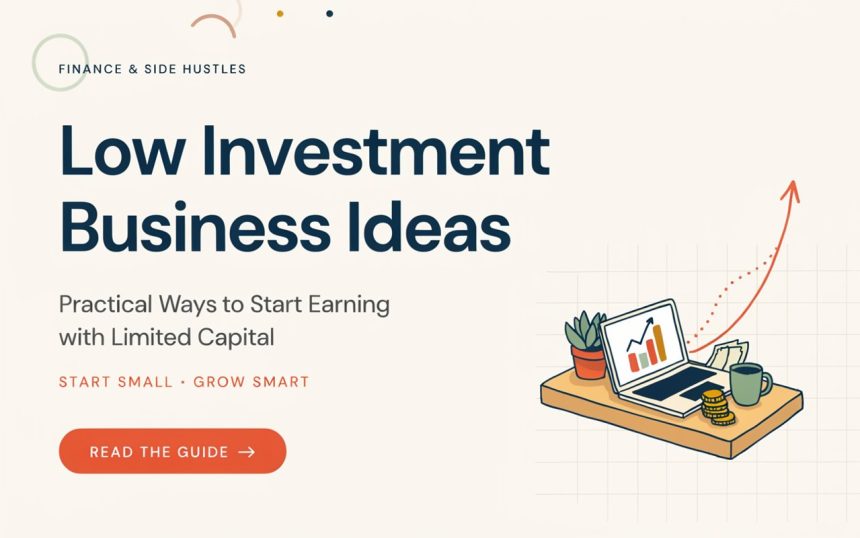
Looking for low investment business ideas that can realistically start earning money without draining your savings? Starting a business used to mean renting a shop, hiring staff, and putting your savings on the line before you’d made a single sale. That’s no longer true. Between digital tools, remote work platforms, and print-on-demand suppliers who handle inventory for you, it’s genuinely possible to launch a real, income-generating business today with a few hundred dollars — sometimes less.
This guide walks through the most realistic low-investment business models available right now, what each one actually costs to start, how long it typically takes to see your first income, and who each idea suits best. Nothing here promises overnight riches — but every idea below is one real people are running profitably today.
Why Low-Investment Businesses Work Better Than Ever
A few genuine shifts in the business landscape have made this possible:
Digital tools removed the biggest traditional costs. Website builders, accounting software, and design tools that once required expensive licenses or specialized staff are now available as affordable monthly subscriptions — or free.
Marketplaces removed the need for inventory. Platforms that connect you directly to manufacturers, print shops, and suppliers mean you can sell physical products without ever storing a single box in your home.
Remote work normalized service businesses. Clients are now comfortable hiring freelancers, virtual assistants, and consultants they’ve never met in person, which opens up a global client base to anyone with a laptop.
AI tools cut the time cost of skilled work. Tasks that used to require hiring a small team — content editing, basic research, first-draft design work — can now be handled by a single person using AI tools as a force multiplier, which lowers both the cost and time needed to deliver a service.
With that context in mind, here are the ideas worth seriously considering.
1. Freelance Writing and Content Services
If you can write clearly, this is one of the lowest-barrier businesses available. Companies of every size constantly need blog posts, website copy, email campaigns, and product descriptions, and most freelance work starts with nothing more than a portfolio and a profile on a platform like Upwork or Fiverr.
- Startup cost: Essentially $0–$50 (a laptop you likely already own, plus optional portfolio hosting)
- Time to first income: A few days to a few weeks, depending on how quickly you land your first client
- Best for: People comfortable writing under deadline, who can also handle basic research and editing
Specializing helps enormously here. Writers who focus on a specific industry — finance, healthcare, SaaS, or legal content, for example — can charge noticeably more than generalists, because clients in regulated or technical industries are willing to pay a premium for someone who already understands their space.
2. Virtual Assistant Services
A virtual assistant (VA) handles administrative work remotely — inbox management, scheduling, data entry, customer support, or basic bookkeeping — for busy business owners who don’t need (or can’t afford) a full-time employee.
- Startup cost: $0–$100 (a computer and reliable internet is usually enough to start)
- Time to first income: 1–4 weeks
- Best for: Organized, detail-oriented people who enjoy varied, task-based work
The VA space has changed meaningfully in the last couple of years. Rather than competing purely on cheap hourly admin work, many VAs now position themselves around a specific outcome — research-heavy support, content coordination, or operations management — which lets them charge closer to agency rates while still working solo.
3. Print-on-Demand Store
Print-on-demand lets you design products — t-shirts, mugs, phone cases, notebooks — without ever manufacturing or storing them yourself. When a customer orders, your supplier prints and ships the item directly, and you keep the difference between your selling price and the supplier’s base cost.
- Startup cost: $0–$100 (most platforms are free to connect; you may want a small budget for design software or ads)
- Time to first income: 2–8 weeks, depending on how quickly your marketing gains traction
- Best for: People with a design sense or a specific audience/niche they already understand
The businesses that do well here tend to go narrow rather than broad — designs built around a specific hobby, profession, or community tend to outperform generic “funny t-shirt” stores, because a focused audience is easier to reach and more likely to buy.
4. Virtual Bookkeeping
Small businesses need their books kept accurate and current, but most can’t justify hiring an in-house accountant. A growing share of small and mid-sized businesses now outsource this work entirely, which has created steady, recurring demand for bookkeepers who can work remotely using cloud accounting software.
- Startup cost: $200–$500 (covers accounting software access and, often, a beginner certification course)
- Time to first income: 4–8 weeks, since building trust with financial clients usually takes longer than other service businesses
- Best for: Detail-oriented people comfortable with numbers; prior bookkeeping or accounting exposure helps but isn’t always required
This is one of the more stable options on this list, because bookkeeping is recurring by nature — a client who hires you tends to keep you for months or years, rather than a single one-off project.
5. Pet Care Services (Dog Walking and Pet Sitting)
Pet ownership continues to grow, and pet owners increasingly treat pet care as a non-negotiable household expense rather than a luxury. Dog walking and pet sitting remain some of the most reliable low-investment local businesses because the barrier to entry is almost nonexistent.
- Startup cost: $0 (platforms like Rover connect you with clients directly; a leash and some flyers are optional extras)
- Time to first income: Can be same-day if you sign up on an existing platform
- Best for: Animal lovers who want flexible, local, low-tech work
Many pet sitters start on a platform to build reviews and a client base, then transition to working independently once they have repeat clients, which increases their margin since they’re no longer paying a platform commission.
6. Home Cleaning Services
Home and office cleaning remains one of the most dependable local service businesses, largely because demand doesn’t disappear during economic slowdowns the way discretionary spending does — people still want a clean home even when they’re cutting back elsewhere.
- Startup cost: $100–$300 (basic cleaning supplies and transportation)
- Time to first income: 1–3 weeks
- Best for: People who prefer hands-on, local work and don’t mind physical labor
This business scales in a straightforward way: once you have more clients than you can personally handle, you can hire help and shift into managing a small team, turning a solo service into an actual small company.
7. Social Media Management
Many small businesses know they should be active on social media but don’t have the time, strategy, or content skills to do it well. If you understand content creation, basic analytics, and how different platforms work, you can offer this as a paid service.
- Startup cost: $0–$100 (some scheduling tools have free tiers; paid tools add convenience but aren’t mandatory)
- Time to first income: 2–6 weeks
- Best for: People who already understand social platforms and enjoy content strategy
This service has room to expand naturally — many social media managers eventually add paid ad management, influencer outreach, or content production as additional paid services once they’ve built a track record with a client.
8. Niche Blogging or Content Websites
Building a content website around a specific topic — and monetizing it through advertising, affiliate marketing, or digital products — remains a legitimate low-cost business model. The main investment is a domain name and hosting, both of which are inexpensive.
- Startup cost: $50–$200 per year (domain and hosting)
- Time to first income: Several months to a year — this is a slower-building model than most others on this list
- Best for: People willing to commit to consistent publishing over a longer time horizon, ideally with existing knowledge in a specific niche
The single biggest factor separating successful content sites from ones that never gain traction is focus. Sites that go deep on one clearly defined topic and consistently publish genuinely useful, accurate content tend to build trust with both readers and search engines far faster than sites that cover many unrelated topics.
9. AI-Augmented Services
A newer category has emerged as AI tools have matured: service businesses where a single person delivers work that used to require a small team, using AI tools to handle a large share of the workload while the person manages quality, client relationships, and final output. This includes AI-assisted content editing, resume writing, basic chatbot setup for small businesses, and light automation work for companies that don’t have their own technical staff.
- Startup cost: Under $500 in most cases (AI tool subscriptions plus your existing skills)
- Time to first income: 2–8 weeks
- Best for: People comfortable using AI tools as an assistant rather than a replacement — clients are paying for your judgment and oversight, not just the AI output
This category is growing quickly, but it also requires the most care: clients hire you for reliable, checked, high-quality output, not raw AI-generated work, so building a reputation for quality control is what actually creates repeat business here.
10. Local Food and Catering Services
If cooking is a genuine skill or passion, a home-based food or catering business can start small — a few local events — and scale as your reputation grows, provided you follow your local food safety and licensing regulations.
- Startup cost: $200–$1,000 (ingredients, basic licensing, and packaging for early orders)
- Time to first income: 2–6 weeks
- Best for: People with genuine cooking skill who enjoy word-of-mouth, community-based marketing
Word-of-mouth and social media are unusually powerful in this category compared to others, since food is inherently shareable — a satisfied customer posting a photo often does more marketing work than a paid ad would.
How to Choose the Right One for You
With ten legitimate options on the table, the right choice depends on three honest questions:
What do you already know how to do? The fastest path to your first paying client is almost always a skill you already have, not one you need to learn from scratch. Learning a brand-new skill before launching adds months to your timeline.
How much uncertainty can you tolerate? Local service businesses (cleaning, pet care) tend to have the highest success rates because demand is predictable and immediate. Content-based businesses (blogging, social content) take longer to pay off but can scale further once established.
How much time do you have before you need income? If you need money quickly, lean toward local services or freelance work, where the gap between starting and your first payment is usually just days or weeks. If you can afford to build patiently, content and audience-based businesses can eventually produce more passive income.
Common Mistakes to Avoid
Skipping validation. Before investing any time or money, talk to a handful of real potential customers and confirm they’d actually pay for what you’re planning to offer. It’s far cheaper to find out your idea needs adjusting before you launch than after.
Overbuilding before your first sale. Elaborate websites, business cards, and branding feel productive, but they don’t generate income. Launch with the minimum you need to serve one real customer well, then improve based on what you learn.
Ignoring ongoing costs. Even low-investment businesses have recurring expenses — software subscriptions, marketing, and in some cases licensing fees. Budget for these from day one rather than being surprised by them later.
Underpricing your work. Many first-time business owners set prices too low in an effort to win their first clients, then struggle to raise prices later without losing those same clients. Research what others in your space genuinely charge before settling on your own rate.
Conclusion
None of the businesses above require you to take on debt, quit your job overnight, or gamble your savings. What they do require is picking an idea that genuinely matches a skill you already have, validating that real people will pay for it, and being consistent long enough to build a reputation. The businesses that succeed in 2026 aren’t necessarily the ones with the biggest budgets — they’re the ones that solve a clear problem for a clear group of people, reliably, over time. Start small, prove the idea works with real paying customers, and reinvest as you grow rather than trying to build everything at once.
Frequently Asked Questions
How much money do I actually need to start a low-investment business? Most of the ideas above can realistically be started for $100–$1,000, and several — freelance writing, virtual assistance, dog walking — can be started for close to $0 if you already own a laptop and internet connection.
Which low-investment business is the most reliable? Local service businesses, particularly home cleaning and pet care, tend to have the highest success and retention rates, since demand for them is steady and doesn’t depend on unpredictable trends the way some online businesses do.
Which option has the highest income potential? Recurring service businesses like bookkeeping and AI-augmented digital services tend to have the strongest ceiling, since they combine relatively low overhead with the ability to serve clients on an ongoing, recurring basis rather than a single project.
Do I need a business license to start? It depends on your location and the type of business. Food-related businesses almost always require some form of local health and safety registration, while freelance and digital services often have lighter requirements. It’s worth checking your local regulations before you start taking payments.
Can I really start with no money at all? Yes, for skill-based services like writing, virtual assistance, tutoring, or consulting — if you already own a computer and have a marketable skill, your only real investment is time.
How long does it typically take to become profitable? Service-based businesses (cleaning, pet care, bookkeeping, freelancing) often become profitable within the first one to two months, since almost every dollar coming in is direct income. Content and audience-based businesses typically take much longer — often six months to a year — before they generate meaningful revenue.