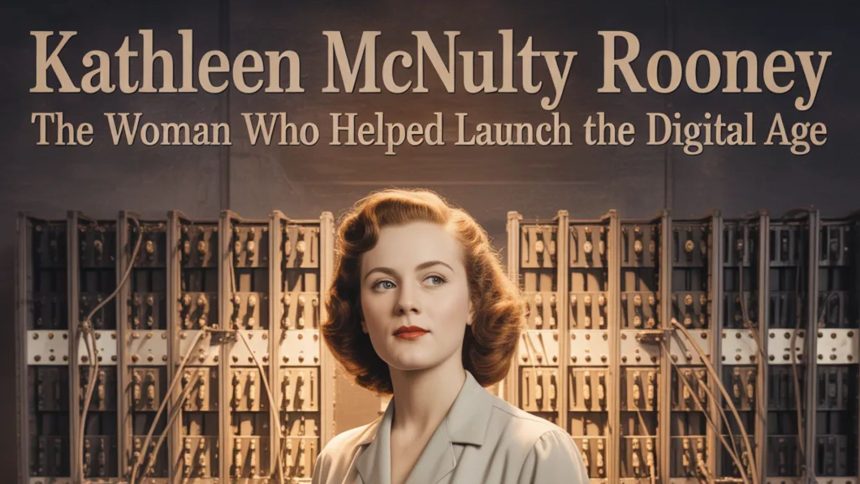
When we think about the birth of modern computing, most of us picture giant machines, blinking lights, and perhaps a few brilliant men in lab coats. But what if I told you that one of the key pioneers behind the world’s first electronic computer was a young Irish immigrant woman with a sharp mind and unstoppable determination?
That woman was Kathleen McNulty Rooney, better known later in life as Kay Mauchly. Her story is not just about technology—it’s about courage, opportunity, and rewriting history. Let’s take a closer look at the life of a woman who quietly helped shape the digital world you and I use every single day.
Early Life: From Ireland to America
A Childhood Marked by Change
Kathleen McNulty was born on February 12, 1921, in County Donegal, Ireland. Her early years were not easy. Ireland was going through political upheaval, and her family faced serious risks because of her father’s political involvement.
Seeking safety and opportunity, her family emigrated to the United States when she was just three years old. They settled in Philadelphia, a city that would later play a central role in her life and career.
Imagine being uprooted from your homeland as a child and starting over in a new country. That journey shaped her resilience and adaptability—qualities that would later serve her well in the world of computing.
Education: A Brilliant Mind in Mathematics
Discovering a Passion for Numbers
At a time when higher education was rare for women, Kathleen excelled in school. She attended Chestnut Hill College in Philadelphia, graduating in 1942 with a degree in mathematics.
Now, let’s pause for a second. In the 1940s, very few women pursued advanced degrees in math. It was considered a “male” field. But Kathleen wasn’t interested in stereotypes. She loved numbers, patterns, and logical thinking.
Her mathematical training would soon open the door to a revolutionary project.
World War II: Opportunity Meets Urgency
The War’s Unexpected Impact on Women
World War II created an unusual situation. Many men were serving overseas, leaving technical positions vacant. The U.S. Army needed people who could calculate complex ballistic trajectories—essentially predicting where artillery shells would land.
That’s where Kathleen came in.
She was hired as a “computer.” At that time, the word didn’t mean a machine—it meant a person who performed calculations by hand. She worked alongside other talented women solving equations that were critical for the war effort.
It may not have sounded glamorous, but this job would soon place her at the center of technological history.
The Birth of ENIAC: A Revolutionary Machine
Enter the Electronic Era
In 1945, Kathleen was selected to work on a top-secret project at the University of Pennsylvania. The project was called ENIAC, short for Electronic Numerical Integrator and Computer.
ENIAC was massive—filling an entire room. It weighed about 30 tons and contained nearly 18,000 vacuum tubes. It wasn’t sleek or portable like your smartphone. Think of it as a mechanical giant with a brain made of wires.
But here’s the catch: ENIAC had no programming manual. No one had ever built anything like it before.
And that’s where Kathleen and five other women stepped in.
Programming Without a Blueprint
The Original Coders
Kathleen McNulty was one of six women chosen to program ENIAC. These women had to figure out how the machine worked simply by studying its wiring diagrams and logical structures.
There were no textbooks. No YouTube tutorials. No online forums. Just raw intelligence and determination.
Programming ENIAC wasn’t as simple as typing lines of code. It required physically plugging cables and flipping switches in precise configurations. If something went wrong, you had to trace the error through a maze of wires.
Imagine trying to assemble a 1,000-piece puzzle without a picture on the box. That’s what they were doing—only the puzzle could change the future of humanity.
Recognition Delayed: The Hidden Figures of Computing
Forgotten at the Launch
In 1946, ENIAC was unveiled to the public. It was hailed as a breakthrough in science and engineering. Newspapers covered the story. Photographs were taken.
But here’s something that might surprise you: the women who programmed it were not introduced as key contributors. In many cases, they weren’t even named.
While the male engineers received praise, the women were largely overlooked. It wasn’t intentional cruelty—it was simply the mindset of the time. Programming was seen as clerical work, not intellectual innovation.
Decades would pass before their contributions were fully acknowledged.
Marriage and Collaboration with John Mauchly
A Personal and Professional Partnership
Kathleen later married John Mauchly, one of ENIAC’s co-inventors. After their marriage, she became known as Kathleen McNulty Mauchly.
Together, they worked on developing new computing technologies. She contributed to early software development and helped shape ideas that would influence future systems.
However, as was common in that era, much of her work was attributed to her husband or went undocumented.
Still, her influence continued quietly behind the scenes.
Life Beyond ENIAC
Raising a Family While Supporting Innovation
After John Mauchly’s death in 1980, Kathleen later married and became Kathleen McNulty Rooney. She spent many years raising children and supporting her husband’s business ventures.
Balancing family life with intellectual contributions wasn’t easy. Yet she managed both with grace.
Even though she stepped away from the spotlight, she remained proud of her early work. She understood that what she had helped build was more than a machine—it was the beginning of a new era.
Rediscovery in the 1980s
History Corrects Itself
In the 1980s, historians began revisiting the origins of computing. That’s when the story of ENIAC’s women programmers resurfaced.
Interviews were conducted. Documentaries were made. The women were finally recognized as pioneers.
Kathleen expressed mixed feelings. She wasn’t bitter—but she did acknowledge that it would have been nice to receive credit earlier.
Still, she was grateful that the record had been set straight.
Awards and Honors
Well-Deserved Recognition
Over time, Kathleen and her fellow programmers received several honors. In 1997, she and the other ENIAC programmers were inducted into the Women in Technology International Hall of Fame.
Universities, tech organizations, and historians began highlighting their achievements. Their story inspired a new generation of women entering science, engineering, and mathematics.
Recognition may have been delayed, but it was not denied forever.
The Legacy of Kathleen McNulty Rooney
Why Her Story Still Matters
So why should we care about Kathleen’s life today?
Because every time you use a smartphone, send an email, or stream a video, you’re benefiting from foundations laid by early computer pioneers like her.
She represents more than technical achievement. She symbolizes perseverance, equality, and intellectual courage.
Her journey reminds us that innovation isn’t just about machines—it’s about people. And sometimes, the most important contributors are the ones history almost forgets.
Women in Tech: Breaking Barriers Then and Now
From Wires to Code
The story of ENIAC’s programmers challenges the myth that technology has always been male-dominated. In fact, many early programmers were women.
Over time, cultural shifts changed that dynamic. But today, efforts are underway to encourage more girls and women to pursue careers in STEM fields.
Kathleen’s story serves as both inspiration and reminder: talent has no gender.
Like seeds planted in quiet soil, her contributions have grown into forests of innovation.
Personal Reflections: What Can We Learn?
If there’s one lesson from Kathleen McNulty Rooney’s life, it’s this: don’t underestimate the power of quiet brilliance.
She didn’t chase fame. She didn’t demand headlines. She simply did the work—carefully, thoughtfully, and brilliantly.
And sometimes, that’s enough to change the world.
Conclusion
The story of Kathleen McNulty Rooney is one of resilience, intellect, and delayed recognition. From a young Irish immigrant to a pioneering computer programmer, she helped build one of the most important machines in history.
Her contributions to ENIAC were foundational to modern computing, even if the world didn’t immediately notice. Today, her legacy stands as proof that innovation often comes from unexpected places—and that history, though sometimes slow, can still set the record straight.
In remembering her, we honor not just one woman, but all the overlooked pioneers whose work shapes our lives in ways we may never fully see.
Frequently Asked Questions (FAQs)
1. Who was Kathleen McNulty Rooney?
Kathleen McNulty Rooney was one of the six original programmers of ENIAC, the first general-purpose electronic computer. She was an Irish-born mathematician who played a key role in early computing history.
2. What was ENIAC used for?
ENIAC was initially developed during World War II to calculate ballistic trajectories for artillery. Later, it was used for various scientific and engineering calculations.
3. Why were the ENIAC women programmers not recognized earlier?
At the time, programming was considered clerical rather than intellectual work. As a result, the women’s contributions were overlooked, and recognition came decades later.
4. Did Kathleen McNulty continue working in computing after ENIAC?
Yes, she continued contributing to computing projects alongside her husband John Mauchly and supported the development of early computer technologies.
5. What is Kathleen McNulty Rooney’s legacy today?
Her legacy lies in helping launch the digital age and inspiring future generations of women in science, technology, engineering, and mathematics fields.